 Spoofy
How to See Who Liked You on Tinder Without Gold (2026 Guide)
Tinder Gold's main selling point is the "Likes You" list. Pay roughly $30 a month and you get a grid of every person who's already swiped right on you, with their full unblurred photos. You can pick the matches you actually want instead of swiping blind. For a lot of people, this is the only feature that justifies upgrading. So naturally, the question "how to see who liked you on Tinder without Gold" gets asked a lot. Here's what actually works in 2026, what used to work and doesn't anymore, and where the realistic limits are.
What Tinder Gold actually shows you
Before we talk about workarounds, it's worth understanding exactly what you're trying to replicate.
When you subscribe to Gold, a new tab appears in the app called Likes You. Inside, you see every person who has swiped right on your profile in the recent past, displayed as a grid of square card thumbnails. Each card shows their first photo, their first name, their age, and how far away they are. Tap any card and you see their full profile. From there you can like back (instant match) or pass.
The list typically holds 50 to a few hundred profiles depending on how many people have actually liked you. It refreshes as new likes come in. Some people stay on the list for weeks if you never act on them; others drop off based on their own activity, deletion, or undisclosed Tinder rules.
This is the feature you're trying to recreate without paying. The honest summary is that you can get close, but you can't fully replicate it without a subscription, because the underlying data (the exact identities of who liked you) sits behind a paid API endpoint that Tinder protects.
The blurred photo trick (used to work, doesn't anymore)
If you're searching this topic, you've probably read about the blurred photo trick. It worked roughly like this. Before Gold was launched, Tinder briefly showed a teaser of "X people liked you" on the main screen with blurred grid thumbnails. Some users figured out that if you opened DevTools in a browser session and looked at the raw image URLs, the blurred versions came from the same image source as the unblurred ones, and you could request the unblurred file directly by changing a URL parameter.
This was patched within months. The blurred thumbnails Tinder shows today are generated server-side as actual blurred images. The unblurred versions are not addressable from the client. The trick no longer works, and anyone telling you it does in a 2025 or 2026 blog post is either copy-pasting old content or actively lying.
There have been a few variations of the same idea over the years. Some involved spoofing the user agent to look like a paying account. Some involved intercepting the API response and decoding fields that weren't supposed to be exposed. All of them have been closed for at least three years. Tinder's backend doesn't return the unblurred likes-you data to non-paying accounts at any layer the client can reach.
The rapid swipe right approach (works, has a real cost)
The crude method that genuinely works: swipe right on everyone in your recommendation queue. The people who already liked you will produce instant matches as soon as you like them back. After a hundred or two hundred rapid right-swipes, you'll have a pile of new matches representing the subset of your Likes You list that happened to be in your active recommendation pool.
This works because of how the Tinder algorithm surfaces profiles. The recommendation queue you see is curated, and one of the heavy weighting factors is "has this person already swiped right on me." Tinder wants to show you matches because matches are sticky engagement. So a meaningful fraction of the profiles you see early in any session are people who've already liked you.
The cost of this approach is that you burn through your free like budget without using your judgment, you generate matches with people you might not actually want, and the matches you do get are diluted in a sea of "well, I guess we matched" pairings. It's the equivalent of trying to find a particular person in a crowd by shouting at everyone until they react.
It's also a one-shot strategy. Once you've blasted through your recommendation queue, the next batch of profiles Tinder serves you contains fewer people who liked you (because you already matched with most of them), so the second wave of rapid right-swipes produces fewer matches per swipe. The returns diminish quickly.
For most people, this technique works once or twice and then becomes a waste of swipes.
The probability-scoring approach (what actually works in 2026)
The smarter version of the rapid-swipe technique is to use a tool that scores profiles by their probability of being an already-liked-you match before you spend the swipe.
This works because the Tinder recommendation API returns more information than the official app shows you. Each profile in the response carries metadata about how it ended up in your queue. The presence and ordering of those signals can be used to estimate the likelihood that the person on the other side has already swiped right on you. The signal is not perfect, but on a fresh recommendation batch it's typically accurate enough to identify a top-tier subset where the probability of a match is over 90%.
A few different third-party tools have implemented this scoring over the years with varying degrees of polish. The general approach looks like this. The tool fetches a batch of recommendations from the Tinder API. It analyzes the order, the recommendation metadata, and various other observable fields to assign each profile a score. Profiles with the highest scores (in some implementations labeled with a "likelihood" or "probability" percentage) are the ones most likely to instantly match if you swipe right.
You then prioritize those profiles. You spend your free likes on the high-probability ones first, since each one is essentially a guaranteed match. You skip or pass on the low-probability ones unless you specifically want them. The result is something close to the Gold experience: a curated list of people who probably liked you, presented in order of confidence, that you can act on selectively.
The accuracy depends entirely on the tool and the current state of the Tinder API. A tool that hasn't been updated in a year probably scores poorly because Tinder has rotated some of the signals it relies on. A well-maintained tool in 2026 will typically be 85% to 95% accurate at the top of its confidence ranking.
This isn't the same as paying for Gold. You don't get the full Likes You list. You get a probabilistic ranking of the people in your current recommendation batch, which is a subset of the full list. But for most users it covers the people they'd actually care about, and it's free.
How the probability scoring works under the hood
If you're curious about the technical side, here's a rough sketch.
Tinder's recommendation algorithm has a few well-documented inputs: ELO score (your desirability rating), profile freshness, geographic proximity, the people you've recently interacted with, and the people who've recently interacted with you. The last one is the relevant signal for likes-you detection.
When someone likes your profile, Tinder boosts the priority of returning their profile to you the next time you fetch recommendations. The boost is significant. Profiles of people who liked you typically appear in the first 30% of your recommendation queue, much earlier than they would based on geographic or aesthetic matching alone.
So one way to estimate "did this person like me" is to look at where in the recommendation order they appear and how that ordering correlates with the observable signals about them. A profile that appears unusually early relative to their distance, age compatibility, and other factors is suspicious in a good way: there's some signal weighting them upward, and "already liked you" is the most common cause.
The math isn't exact and the signals are noisy, but the heuristic is good enough that the top tier of a sorted batch is reliably populated with people who already swiped right.
There's also a separate path: Tinder used to leak (and may still partially leak) some account state in API responses that more directly indicates a pending like. Different third-party tools have exploited different subsets of this over the years. Tinder patches these as they find them. As of mid 2026, the heuristic approach is the more reliable long-term technique.
What this actually feels like in practice
If you've never used a probability-scoring tool, here's the user experience.
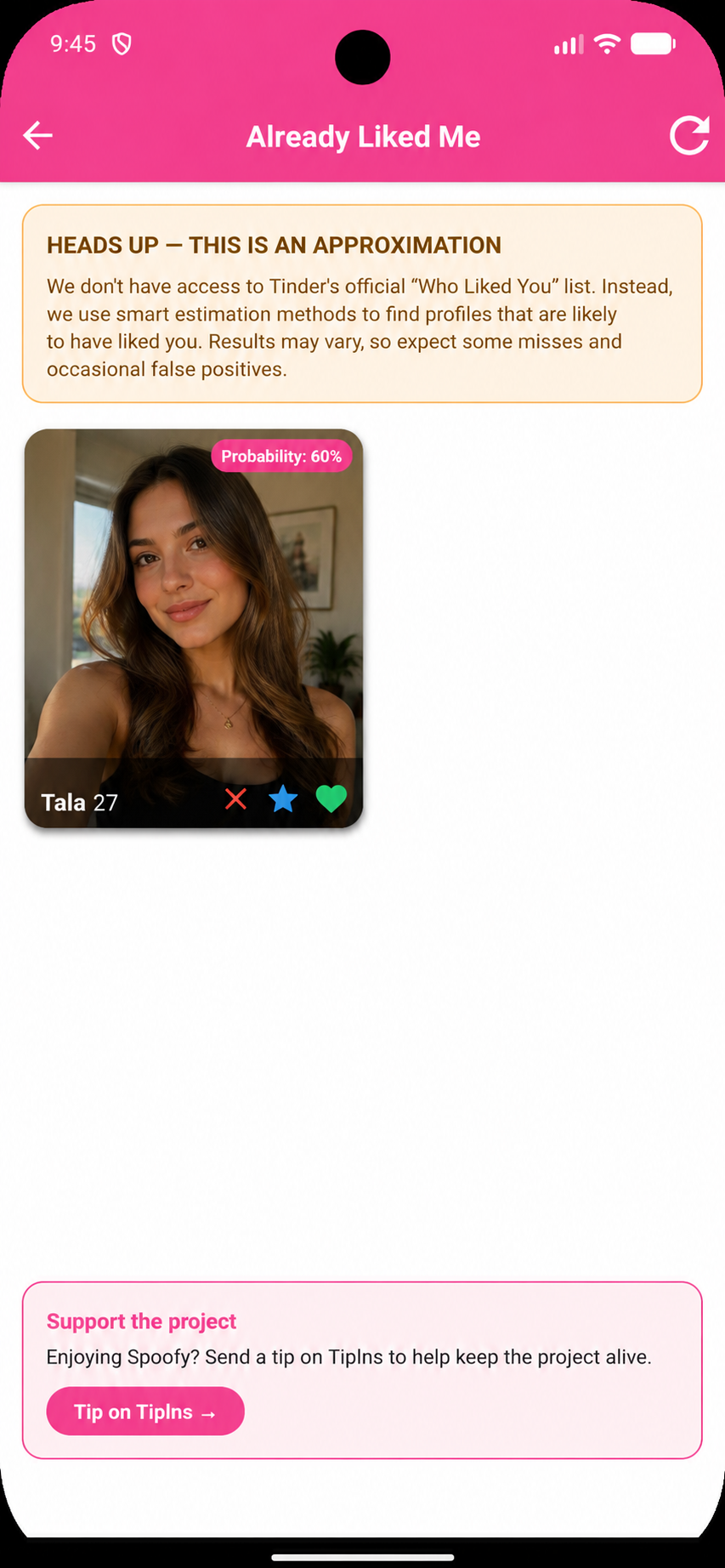
You open the tool. It fetches a batch of profiles in the background, scores each one, and presents them in a grid sorted by likelihood. The top row of cards has badges showing "92%," "89%," "85%" and so on. The bottom of the grid is people the tool thinks probably didn't like you, scored at 30% or 40%, no badge.
You pick the high-confidence ones, batch like them, and the matches roll in. Maybe seven or eight of the top ten produce instant matches. The eleventh is a near miss (someone the tool thought was likely but actually wasn't). The lower-confidence picks have lower hit rates but still occasionally produce surprises.
The whole flow takes a couple of minutes. You spend ten or twelve of your hundred daily likes on near-guaranteed matches instead of spending all 100 on blind swipes. You start your day with eight new matches instead of one.
This is the realistic alternative to Gold for free accounts.
Where the limits are
Be honest with yourself about what this approach can and can't do.
It can't show you literally every person who liked you. Only the ones currently in your active recommendation batch. People who liked you weeks ago and have since gone quiet won't surface this way.
It can't beat Gold's 100% accuracy. Gold tells you exactly who liked you. The probability score gives you a confident guess. There will always be a few false positives in the top of the ranking and a few people the tool misses entirely.
It can't help if you've already burned through your like budget. The scoring tells you which profiles to prioritize, but if you have no likes left, you can't act on the information until the cap resets.
It can't replace good photos and a bio that people actually want to swipe right on. If almost nobody is liking you, the scoring tool will accurately tell you that nobody is liking you. The fix for low like volume is upstream of any third-party tool: better photos, clearer bio, more engaged location.
With those caveats, for users who'd rather not pay $30 a month and who don't mind a slightly worse approximation of Gold's signature feature, this is the realistic 2026 option.
How to get started
The probability-scoring approach requires a third-party Android companion app. I build a free one called Spoofy that includes this feature under the name "Already Liked Me." Profiles in your recommendation batch get scored from 0 to 100% probability and the ones above 90% are flagged with a badge. You can find it at sspoofy.com.
There are other tools in the same category. The general criteria for picking one safely are covered in this post on auto-swipe tools. Look for: signed APK, doesn't ask for your Tinder password, doesn't request accessibility permission, transparent about what data leaves your device.
Whatever tool you pick, the experience and the underlying technique are the same: probabilistic ranking based on observable recommendation signals, then selective likes on the high-confidence picks.
Related reading
For background on how Tinder's like cap actually works and why the "unlimited likes APK" search results are mostly traps, start with this post.
If you're hitting the cap and want to know whether any tool can genuinely bypass the cooldown, the post on Tinder cooldowns covers what does and doesn't work.
For the broader survey of third-party Tinder tools on Android, the auto-swipe bot guide is the umbrella overview.
Comments
Loading comments…